Allergy season 2026
Allergy season got worse. Five reasons the air inside your house is the part to fix.
You closed the windows. You changed the furnace filter. It got worse anyway. Here is why, and the one spec that decides whether a purifier helps.
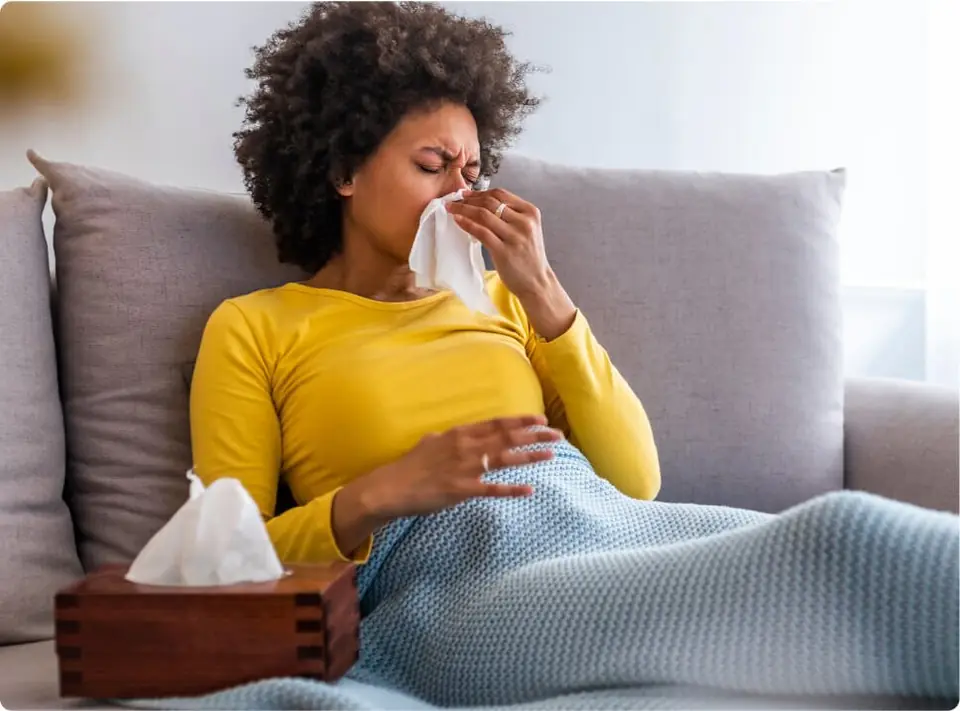
Every spring the advice is the same. Keep the windows shut. Stay in when the count is high. Run the air conditioning. That advice works well for the air on the other side of the glass. It does very little for the air on your side, and in a tight modern house it can make the situation worse.
AirDoctor says this out loud on its own allergy page, which is unusual for a company that sells the fix:
Surprisingly, closing your home to outdoor allergens often makes things worse, it creates a contained environment where contaminants recirculate and build up over time. AirDoctor, airdoctor.com allergy page
That single sentence explains most of the confusion people have in April. You did the right thing, and the room got worse. Below are the five things that actually decide what you breathe between 10pm and 7am, and the one number on a spec sheet that separates a purifier that changes how you wake up from one that just hums in the corner.
Reason 1You spend about 90 percent of your day downstream of your own house
AirDoctor's own figure, and it is the standard one: we spend about 90 percent of our time indoors. The company puts the follow-up point just as plainly, citing the American Lung Association: indoor air can be two to five times more polluted than outdoor air, and in the worst cases up to 100 times.
Nothing in that sentence is about pollen. It is about accumulation. Pollen that rode in on a jacket, a dog or a five second door opening does not leave. Neither does dander, dust, mold spores from the bathroom, cooking smoke, or the gases that come off flooring, furniture, paint, air fresheners and cleaning products. Sealing the envelope is exactly what keeps them in the loop.
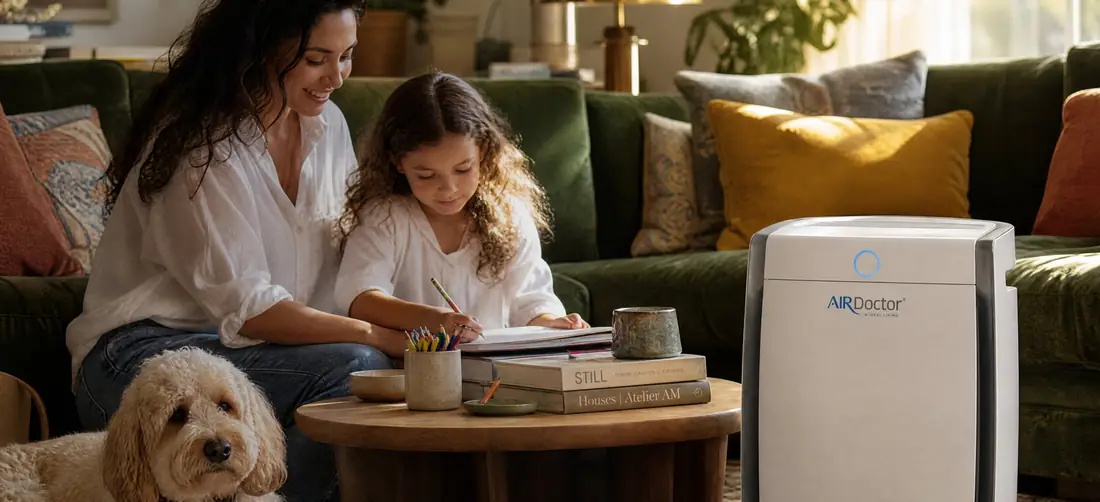
Pollen is the easy part. The rest is the part that stays airborne.
Here is AirDoctor's own particle chart, and it is worth reading slowly, because the size ranges are the whole story.
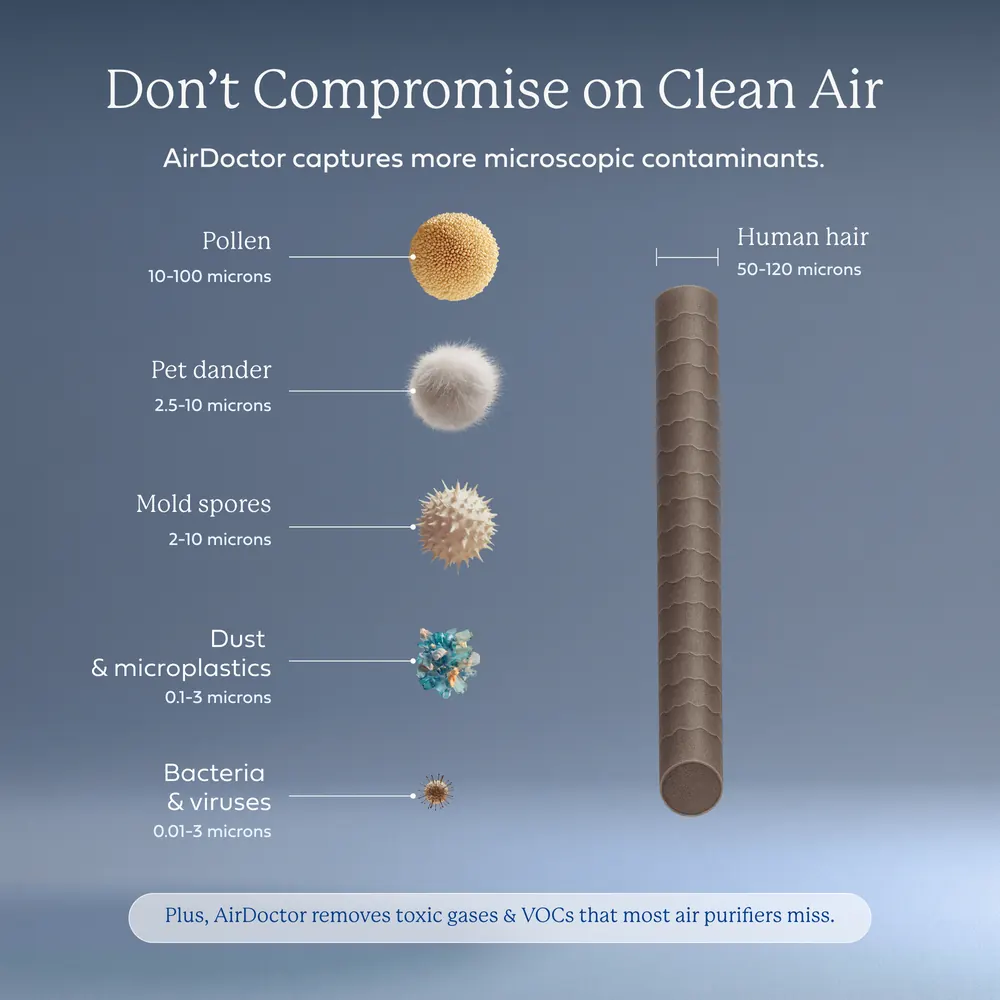
Particle size, to scale
Every size below is as published by AirDoctor. The axis is logarithmic: each step is a tenfold change.
Everything to the left of the HEPA line is where a 1943 rating stops making promises. Most of what stays airborne lives there.
Pollen is enormous. At 10 to 100 microns its larger grains run into the same range as a human hair, which is why a screen door catches some of it and why it settles out of the air fairly quickly. It is also why a cheap filter looks like it is working: the grey mat on the pre-filter is mostly the big stuff.
PM2.5 simply means every particle 2.5 microns and under. Look back at the chart and notice how much of the list falls at or below that line. Dust and microplastics start at 0.1 microns. Bacteria and viruses start at 0.01. Those particles do not settle the way pollen does. They stay suspended, they follow the air currents in the room, and they are the fraction still circulating at three in the morning.
That is why an allergy season can feel worse in a house that looks spotless.
Reason 3Your filter is probably rated for a particle 100 times too big
The word HEPA is a certification, not a brand, and the specification behind it dates to 1943. That is AirDoctor's own framing, printed on its product pages: "HEPA is a 1943 standard." The company states the standard itself just as plainly in its explainer on HEPA filters: a HEPA filter captures 99.97 percent of airborne particles as small as 0.3 microns.
Read that again with the chart in front of you. 0.3 microns is the floor. Below it, the rating stops making promises. And a good part of the PM2.5 fraction lives below it.
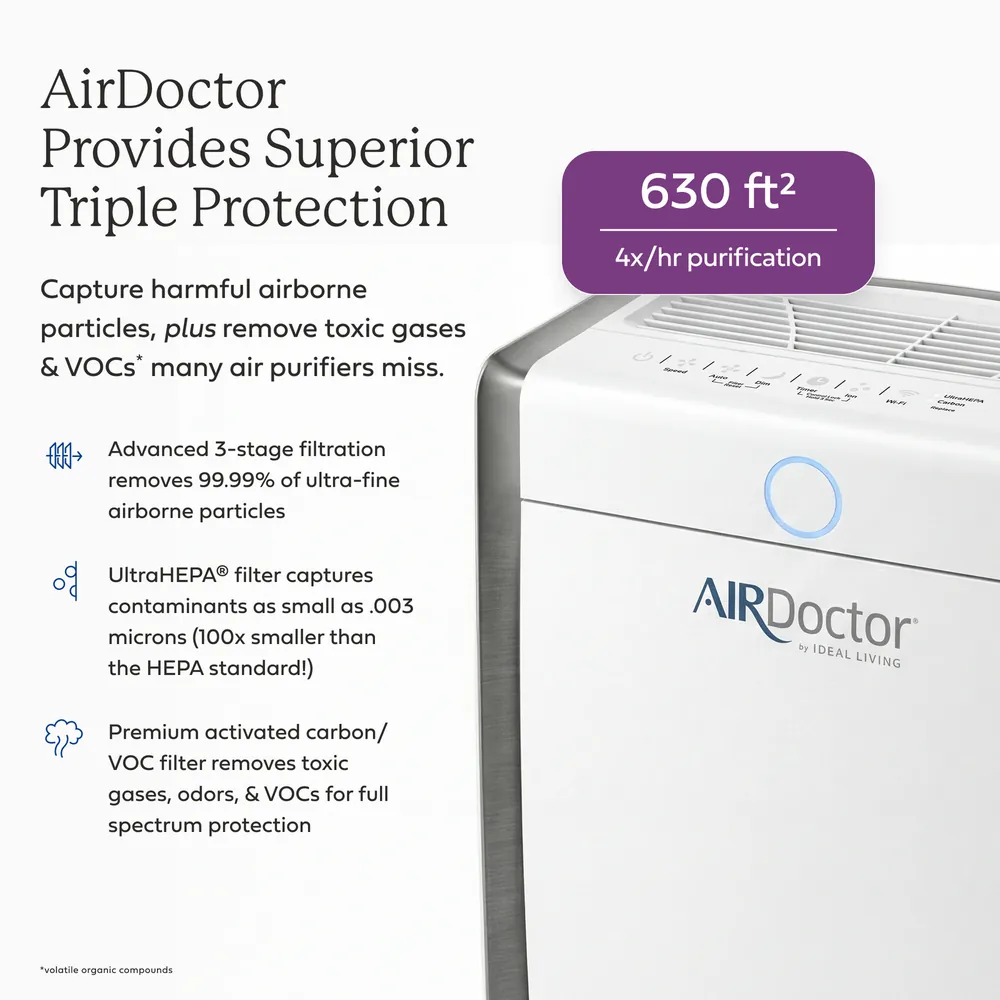
AirDoctor's answer is a filter it calls UltraHEPA, independently tested to capture 99.99 percent of particles as small as 0.003 microns. That is 100 times smaller than the HEPA standard, and it is the single specification that most buyers never compare.
Standard HEPA
0.3 microns
99.97 percent capture rate at that size. A 1943 specification.
AirDoctor UltraHEPA
0.003 microns
99.99 percent capture rate, independently tested. 100 times smaller than the HEPA standard.
Half of what bothers you at home is not a particle at all
This is the part AirDoctor is most direct about, and it is the reason a lot of people feel that their purifier "does nothing" for the stuffy room, the new furniture smell, or the headache after cleaning day.
In the company's own words, HEPA only purifiers do half the job: they remove harmful particles, but do nothing about toxic gases and volatile organic compounds. Ozone and nitrogen dioxide. Benzene and formaldehyde, which come off furniture, flooring, paint, air fresheners and cleaning products. A particle filter, however good, is the wrong tool for a molecule.
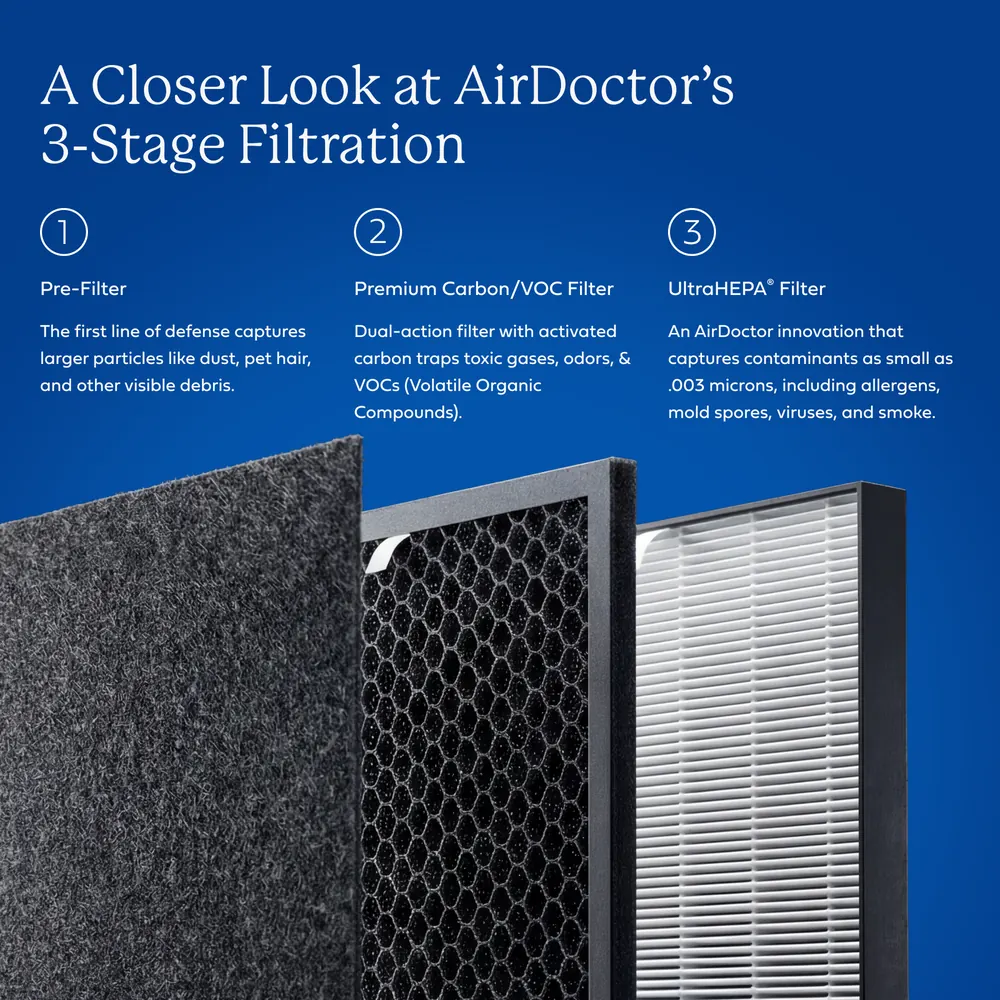
AirDoctor's answer is a carbon filter enhanced with potassium permanganate. In its own description of that filter, the activated carbon traps the gases and VOCs, and the potassium permanganate converts them into stable, non-hazardous by-products. Trapping a molecule is a different job from catching a particle in a mesh, and it is the stage AirDoctor says most air purifiers miss.
Why a filter can be perfect and still miss half of it
A particle has a size. A mesh can stop it.
A gas is a molecule. It goes straight through.
Formaldehyde, benzene, ozone and nitrogen dioxide are molecules, not particles. That is the job AirDoctor gives to the carbon and potassium permanganate stage.
- Three stages, not one. Pre-filter, premium carbon and VOC filter, then UltraHEPA.
- 100 percent sealed system, so unfiltered air is not slipping around the edges of the filter and back into the room.
- Auto mode with an air quality sensor that reads the room and raises or lowers filtration on its own.
- WhisperJet fans, which AirDoctor rates at 30 percent quieter than traditional air purifiers. This matters more than it sounds: a purifier you turn off at night is a purifier that does nothing for the eight hours that count most.
None of it counts if the air only moves once an hour
Here is the number almost nobody checks, and it is the one that decides whether any of the above reaches you.
AirDoctor cites a Harvard University study, itself cited by the CDC, recommending at least four air changes per hour to effectively remove allergens such as smoke, bacteria, viruses, dust and pollen. Four changes per hour means the entire volume of air in the room passes through the filter four times, every hour.
That turns purifier shopping into a room measurement rather than a brand argument. A unit rated for 300 square feet, put in a 600 square foot living room, is not broken. It is simply running at half the rate the recommendation is based on. The specification to compare is CADR, the clean air delivery rate, and the smoke number is the strictest of the three because it reflects the smallest particles.
One air change per hour, or four
Undersized for the room
The room's air passes the filter once an hour. Everything released in between stays in the room.
Matched to the room
The recommendation AirDoctor cites from Harvard, itself cited by the CDC, for allergens, smoke, dust and pollen.
Same purifier, same filter. The only variable is the size of the room you put it in.
| Model | Room at 4 changes per hour | CADR smoke | Price |
|---|---|---|---|
| AirDoctor 1000 | Up to 285 sq. ft. | 152 CFM | $419 |
| AirDoctor 2000 | Up to 305 sq. ft. | 162 CFM | $399 |
| AirDoctor 3500 | Up to 630 sq. ft. | 340 CFM | $659 |
| AirDoctor 4000 | Up to 694 sq. ft. | 370 CFM | $679 |
| AirDoctor 5500 | Up to 1,043 sq. ft. | 556 CFM | $999 |
Coverage, CADR and prices as published on airdoctor.com on August 7, 2026, for the Classic versions. Smart versions with wifi and the air quality app are listed separately.
Room covered at four changes per hour
Square feet, as published by AirDoctor for the Classic versions. Measure the room first, then read this chart.
What the testing actually says
Air purification is a category full of unverifiable claims, so it is worth separating what a brand asserts from what a laboratory measured. These are AirDoctor's published third party results for the AirDoctor 3500.
- 99.97 percent of live SARS-CoV-2 removed from the air in a controlled test chamber, in testing conducted by MRIGlobal.
- 99.99 percent of tested bacteria and viruses, including H1N1, in third party laboratory testing.
- Particles as small as 0.003 microns captured, independently tested.
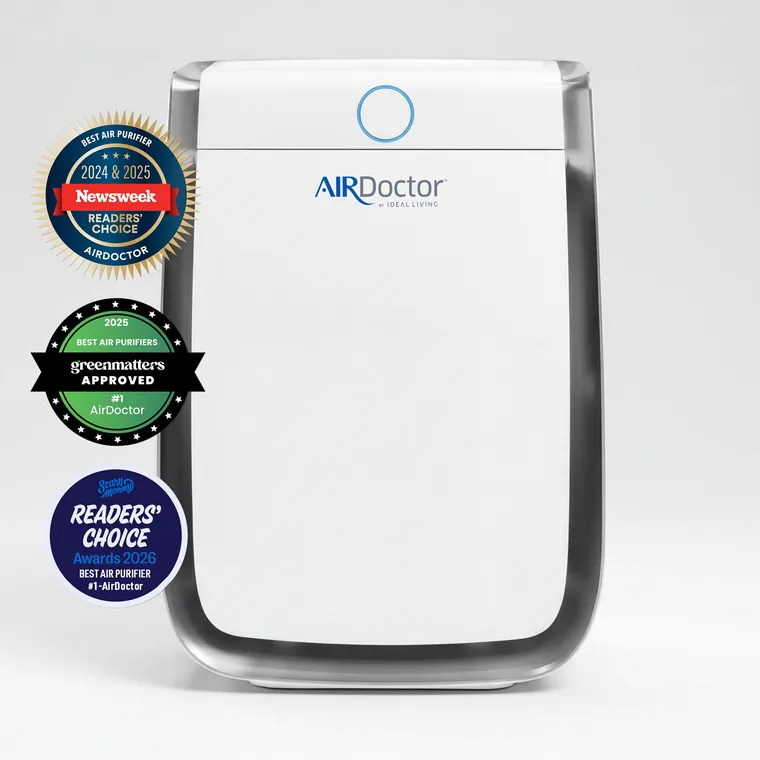
On the recognition side, AirDoctor was voted Best Air Purifier in Newsweek's Readers' Choice awards in 2024 and 2025, and Best Air Purifier in the Green Matters Approved awards.
What owners report after a season with one
AirDoctor surveyed its customers by email. These are the published results.
Based on an email survey of 775 AirDoctor customer respondents, as published by AirDoctor.
A heavy duty air purifier that significantly helped my allergies. Samantha Kelly, CNN Senior Tech Writer, on the AirDoctor 3500
And these are verified customer reviews published on the AirDoctor 3500's product page, which currently carries a 4.7 average across 1,307 reviews.
After plugging in the 3500 AirDoctor in our living room, my allergy symptoms were mitigated so much that I purchase 2 more AirDoctors for other rooms! It has made a wonderful difference for me!
Marilyn D.Verified buyer · December 2025
We have several in our house. We never knew for sure if they were truly making a difference but felt they were. Recently we had to shut them all off and within 3 days the air quality decline was noticeable. Asthma and allergies were felt by everyone. Got them back on and within 24 hrs good again.
Marc G.Verified buyer · September 2025
With the air doctor running all night, I notice I wake up with clear sinuses! A big improvement from before air doctor. Love it.
Kayla D.Verified buyer · March 2026
It is really helping with my allergies. So happy to have two of these in my home now. My air is cleaner and I have noticed an improvement in allergy symptoms.
Sharon L.Verified buyer · May 2026
Superb at cleaning the air and eliminating all my cat allergies! Go ahead and buy yourself this you won't regret
Patricia S.Verified buyer · March 2026
Which one goes in which room
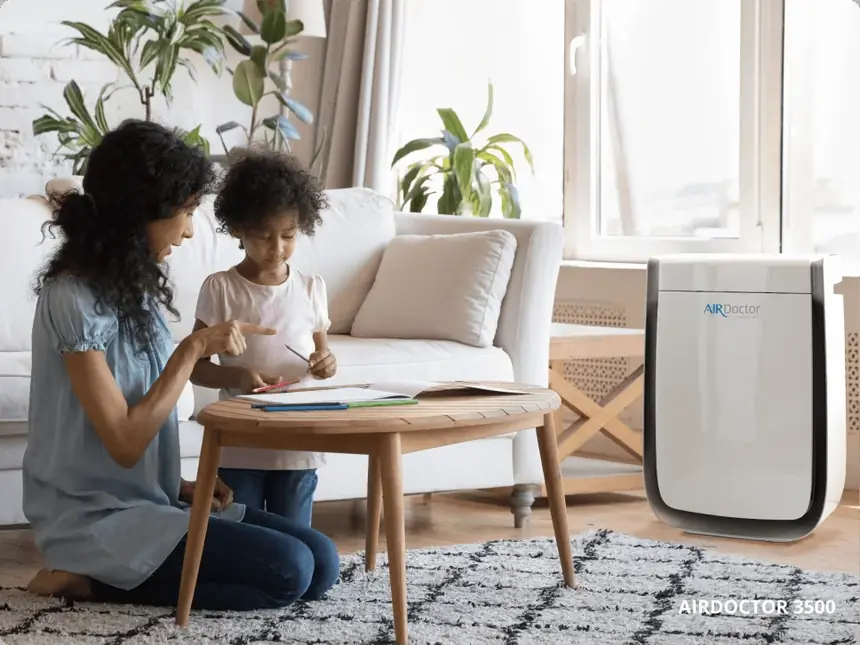
Start with the room you sleep in, because that is where you spend the longest uninterrupted stretch breathing the same air. Then add the room where everyone gathers. Measure the square footage, then pick the model whose four changes per hour rating covers it.
 AirDoctor 2000
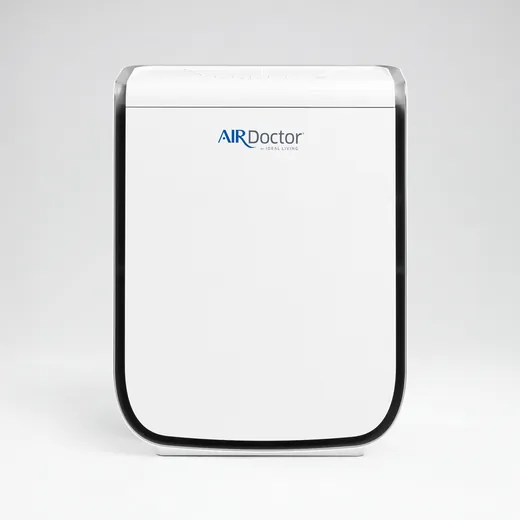
Up to 305 sq. ft. Small bedrooms, nurseries, home offices.
$399 · See it
AirDoctor 2000
Up to 305 sq. ft. Small bedrooms, nurseries, home offices.
$399 · See it
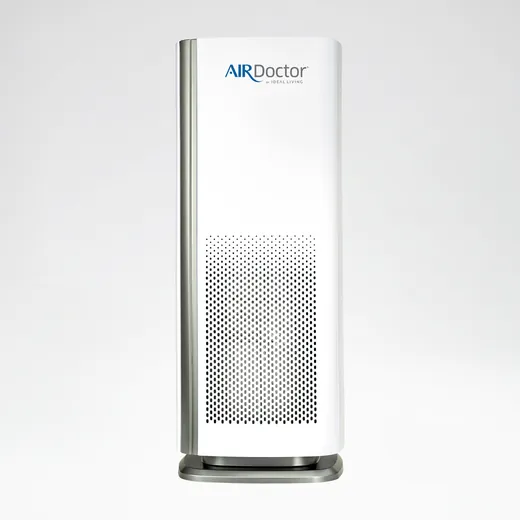 AirDoctor 1000
Up to 285 sq. ft. Small bedrooms, nurseries, laundry rooms.
$419 · See it
AirDoctor 1000
Up to 285 sq. ft. Small bedrooms, nurseries, laundry rooms.
$419 · See it
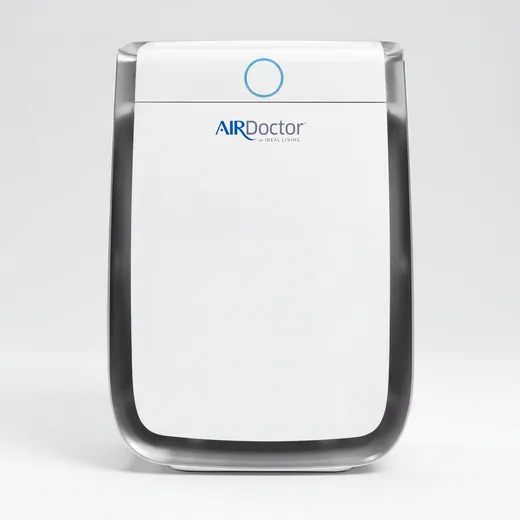 AirDoctor 3500
Up to 630 sq. ft. Primary bedrooms, living rooms, kitchens.
$659 · See it
AirDoctor 3500
Up to 630 sq. ft. Primary bedrooms, living rooms, kitchens.
$659 · See it
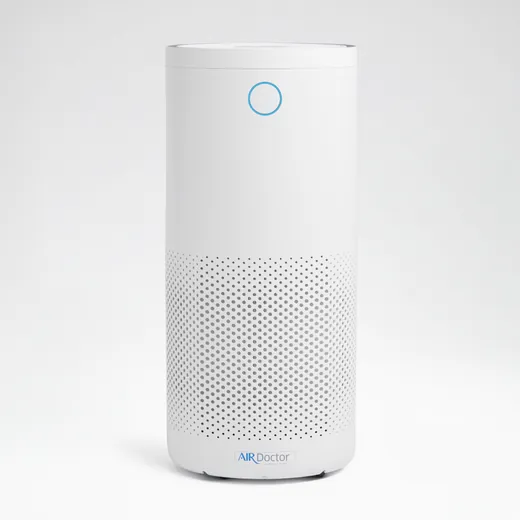 AirDoctor 4000
Up to 694 sq. ft. Large rooms, in white or black.
$679 · See it
AirDoctor 4000
Up to 694 sq. ft. Large rooms, in white or black.
$679 · See it
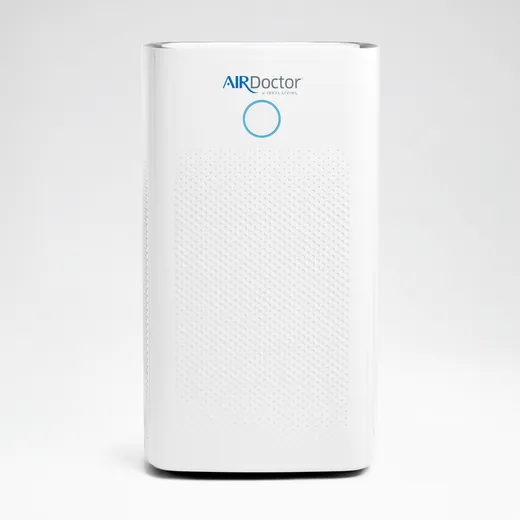 AirDoctor 5500
Up to 1,043 sq. ft. Open concepts, lofts, high ceilings.
$999 · See it
AirDoctor 5500
Up to 1,043 sq. ft. Open concepts, lofts, high ceilings.
$999 · See it
If it does not work, you are not stuck with it
AirDoctor's Breathe-Easy Guarantee: if you do not notice cleaner air within 30 days, return it for a refund of the purchase price, minus shipping and processing. Units carry a one year warranty, and customer service is reachable on 1-800-221-2515. AirDoctor purchases can also be reimbursed through an HSA or FSA via Truemed, if you qualify.
Questions people ask before they buy
Why do air changes per hour matter more than the room size on the box?
Because a purifier can technically "cover" a large room while cycling the air only once an hour. The Harvard study cited by the CDC recommends at least four changes per hour to effectively remove allergens. AirDoctor rates every model at four changes per hour rather than one, so the coverage figures are directly comparable.
What is CADR, and which number should I read?
Clean air delivery rate, measured for pollen, dust and smoke. Higher is better. The smoke figure is the strictest of the three because it reflects the unit's ability to remove the smallest particles, which is why it is the one worth comparing.
How often do the filters need changing, and what does that cost?
On the AirDoctor 4000 and 1000, both the UltraHEPA and Carbon/VOC filters are replaced every six months. On every other model, the Carbon/VOC filter goes every six months and the UltraHEPA filter every twelve. An indicator light tells you when. A one year filter combo pack for the 3000 series is listed at $162.99.
Is it quiet enough to run in a bedroom overnight?
AirDoctor rates its WhisperJet fans at 30 percent quieter than traditional air purifiers, and it calls the 5500 its quietest model. Owners who bought a second and third unit almost always describe putting the first one in the bedroom.
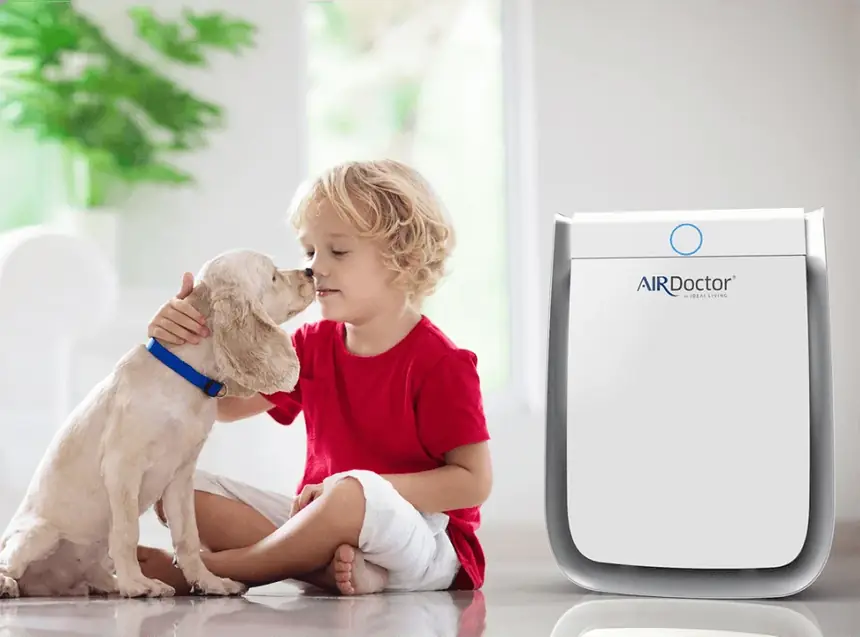
The short version
Closing the house does not remove the allergens, it concentrates them. Pollen is the large, visible, easy fraction. The part that stays airborne overnight is measured in tenths and hundredths of a micron, which is below the 0.3 micron floor that the HEPA standard is written to. Gases are not particles at all and need carbon. And none of it reaches you unless the unit is cycling the room's full volume at least four times an hour.
If you want to fix one room this season, fix the one you sleep in.
See the AirDoctor 3500 630 sq. ft. at four changes per hour · 4.7 stars from 1,307 reviews · 30 day guarantee